مجموعه مقالات فرآیند اکستروژن (Extrusion Process Lectures)،
یک مجموعه کاربردی و مفید از مقالات مرتبط با فرآیند اکستروژن است که
مشتمل بر 8 مقاله به زبان فارسی و 5 مقاله به زبان انگلیسی، تایپ شده، به
همراه تصاویر رنگی، نمودارها، روابط ریاضی و... با فرمت PDF، به ترتیب زیر
گردآوری شده است و همچنین این مقالات می تواند به عنوان منبع کمکی جهت
پایان نامه ها و پروژه های دانشجویی استفاده شود:
مقالات فارسی
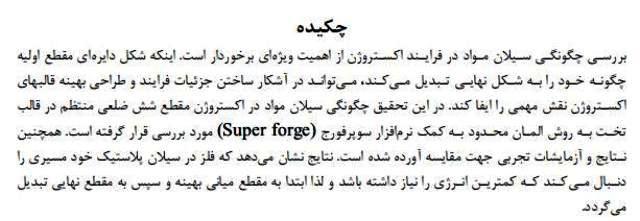
مقاله 1: تحلیل سیلان مواد در فرآیند اکستروژن مقطع شش ضلعی منتظم به روش المان محدود
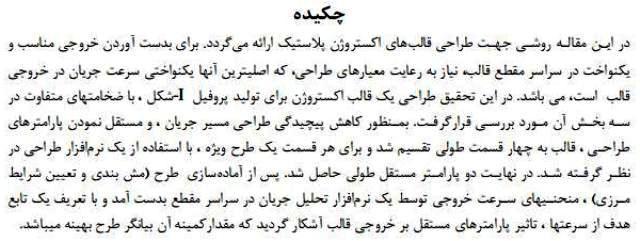
مقاله 2: طراحی قالب اکستروژن پلاستیک به کمک رایانه، توازن سرعت های خروجی
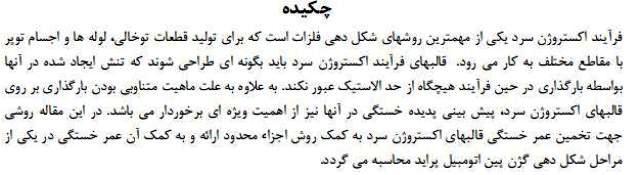
مقاله 3: تدوین روشی جهت تحلیل خستگی قالب های اکستروژن سرد به کمک روش اجزاء محدود
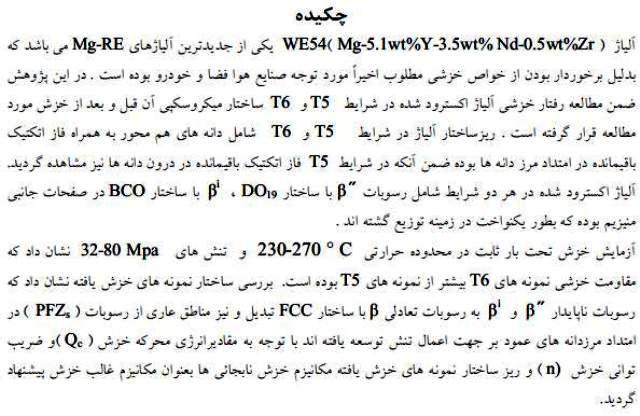
مقاله 4: بررسی ساختار و رفتار خزشی آلیاژ WE54 در شرایط مختلف اکسترود شده
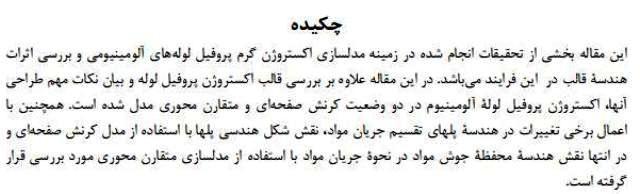
مقاله 5: شبیه سازی فرآیند اکستروژن لوله های آلومنیومی و بررسی نقش هندسه پل های تقسیم جریان مواد و محفظه جوش قالب در این فرآیند
قالب تزریق پلاستیک
قالب آهنگری و فورج
قالب هیدروفرمینگ
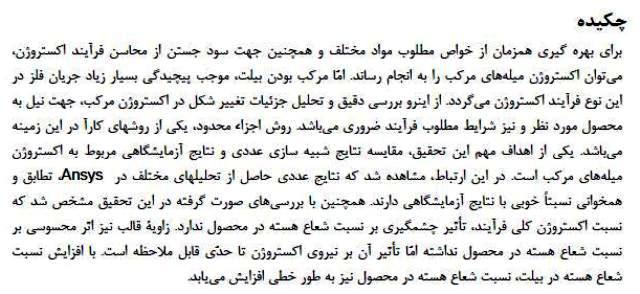
مقاله 6: مطالعه فرآیند اکستروژن مستقیم میله های مرکب مس آلومنیوم
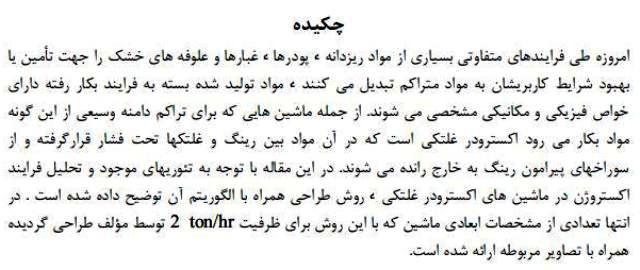
مقاله 7: طراحی ماشین اکسترودر غلتکی جهت گرانولاسیون مواد پودری
مقاله 8: تحلیل فرآیند اکستروژن پیچشی در قالب با سطح مقطع بیضوی با استفاده از روش کران بالا
طراحی قالب و قالب سازی
قالب فلزی و برش
راهنمای جامع طراحی قالب
مهندسی طراحی قالب های تزریق پلاستیک
مقالات انگلیسی
Lecture 1: Experimental and Numerical Study of Optimum Die Profile in Backward Rod Extrusion of Lead
In this
paper, the stress and load relations in backward rod extrusion of lead
have been obtained by the slab method for curved die profile. By the
use of a developed computer program, the optimum die profile has been
obtained on the basis of minimization of stress and load in
die-workpiece contact surface. By using the FEM software, ABAQUS, the
optimum die angle for the conical die is also determined. Then, the
finite-element and experimental load-displacement curves have been
determined. It is illustrated that the extrusion load for optimum curved
die is reduced
by 11%, compared to that in the optimum conical di .
Lecture 2: Automatic Design and Experimental Evaluation of Bearings in Extrusion Dies
This paper deals with the assignment of the bearings in extrusion dies. They are designed automatically based on medial axis transform that is a mathematical transformation method. Besides, a low cost experimental method, named physical modeling, is used to evaluate the designed bearing lengths. Novel software that supports such approach is developed in VisualBasic using API (Application Programming Interface) libraries of SolidWorks. The final 3D model could be used to get machining tool paths for CNC Machines.
Lecture 3: Numerical Study of the Effects of Ultrasonic Vibrations on the Extrusion Process
In
ultrasonic vibration cold forward extrusion, the bars are extruded
while the ultrasonic vibrations are applied to the die. Few attempts
have been made to analyze the wire drawing, deep drawing, upsetting and
rolling processes while the ultrasonic vibrations were applied during
the processes. No attempts have been made to investigate on the effects
of ultrasonic vibrations on the forward extrusion process, yet. A
detailed analysis and understanding of the mechanism of improvement is
not possible on the basis of conventional experimental observations
because ultrasonic vibration processing phenomenon occur at high speeds.
Therefore, in order to advance the understanding of the mechanism of
ultrasonic vibration extrusion, the finite element analysis was used.
The ABAQUS explicit code was used for the FEM. The results were compared
with conventional cold forward extrusion. Simulations were performed
for various amplitudes, frequencies, friction factors and reductions.
Extrusion force versus punch
travel and stress-strain distributions in the extruded parts were
analyzed. From these studies, the improved extrusion characteristics
such as extrusion force and material flow stress were described.
Lecture 4: Prediction of Temperature Distribution during Semi-Solid Forward Extrusion by Using Finite Volume Method
Today
the development of innovative production technologies has became a
major factor in global competition. One of these innovative production
technologies in metal forming field is semi-solid forming (SSF).
Especially for metals that are difficult to process with conventional
technologies, semi-solid metal forming offers the possibility of
significant gains in product quality and productivity of the forming
process. In current study, one of the most conventional procedures
between semi-solid forming processes, i.e. thixo forward extrusion, has
been analyzed. In fact this process has
been simulated by using the SupperForge software that is based on the
finite volume method. As one of the purposed results of simulation,
temperature distribution in whole workpiece at different steps of
forming process has been studied. Based on simulated process results,
temperature distribution can be influenced by different process
parameters including on extrusion ratio, die angle and punch velocity
Lecture 5: Analysis of the effect parameters on the radial extrude (radial forging) process by a 2D finite element method (FEM
Radial
forging is a forging process in which one or two punches move axially
causing a radial flow into a die cavity by means of which a flange is
formed. This process is used in producing of pulley and gears on a
shaft. In this study radial forging process is simulated by a 2D finite
element method (FEM) on a produced laboratory specimen (AL 6061) and
the benefits of FEM simulation such as time and cost saving is
scrutinized. The effective parameters for this forging process are die
corner radius
R), ring gap height (H), friction factor (m), work-hardening
coefficient (n), die clearance and the speed of the punch. The effects
of these parameters on the flange thickness ratio (h/H), the outer
protruding shape ratio (D/D0), effective-strain, warping and reaction
force are also investigated and results were compared with experiments
and theoretical results to confirm the accuracy. It is shown that when
the corner radius is larger, the outer protruding shape ratio (D/D0) is
smaller, and vice versa and when the height of gap is larger the
effective strain distribution is homogeneous and
flowing of material is easier. By increasing of friction factor the
flowing of material becomes nonhomogeneous and D/D0 becomes smaller.
Punch speed has limited effects on strains. Increasing die clearance
has slight effects on reaction forces
جهت دانلود مجموعه مقالات فرآیند اکستروژن (Extrusion Process Lectures) بر لینک زیر کلیک نمایید:
مجموعه مقالات فرآیند اکستروژن (Extrusion Process Lectures)
اگر به فراگیری مباحث مشابه مطلب بالا علاقهمند هستید، آموزشهایی که در ادامه آمدهاند نیز به شما پیشنهاد میشوند:
قالب های تزریق به انضمام 130 طرح قالب آماده اثبات شده
طراحی قالب تزریق پلاستیک (Injection Mold Design)
فرآیندهای پلاستیک
پرس ها
فرآیند فورجینگ
طراحی پلاستیک ها
| | نسخه قابل چاپ | تعداد بازديد : 18 |
 |
|